


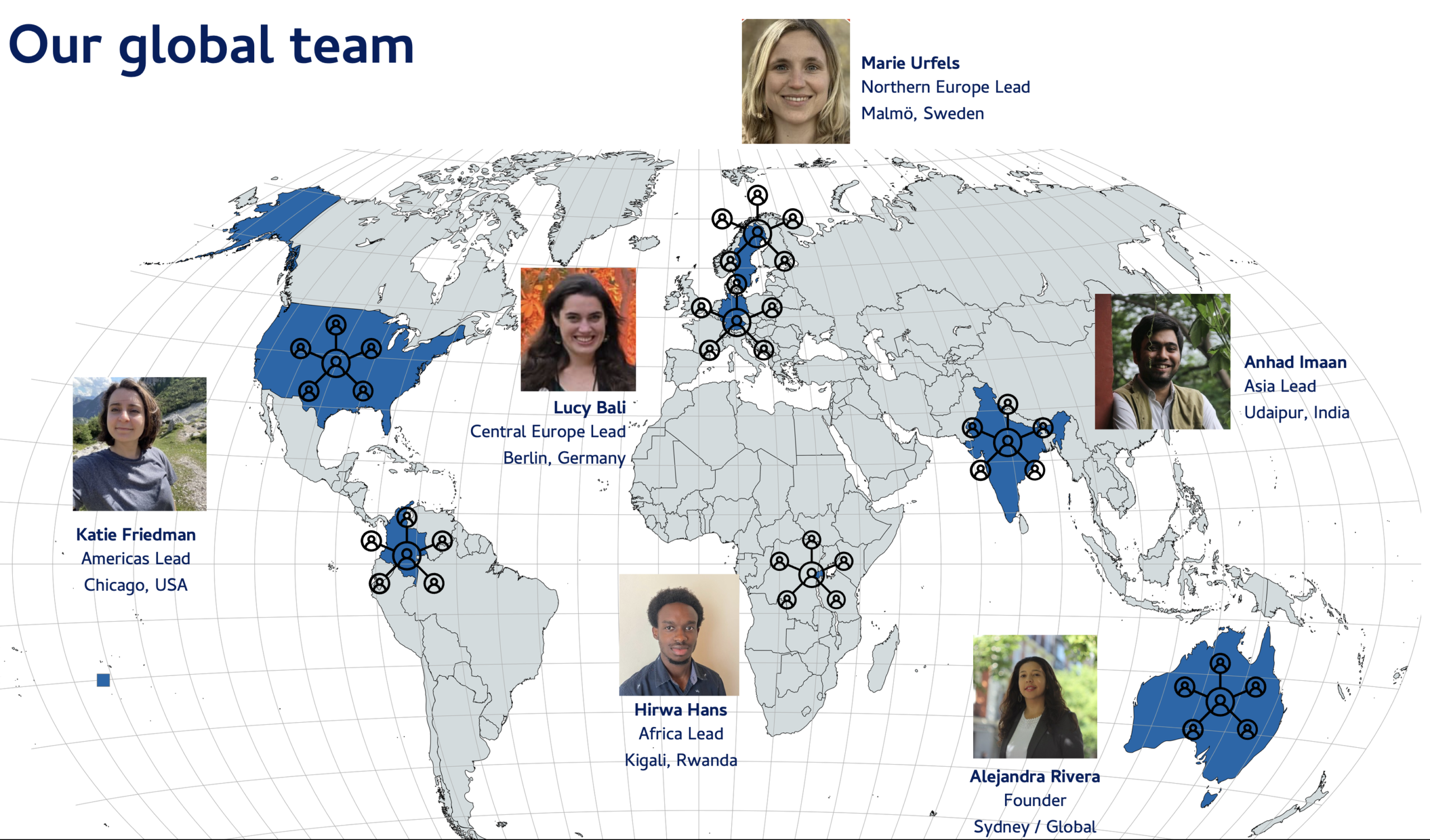

Alejandra Rivera
Founding Urbanist
Urban Matters leader, international urban strategist and social innovator with a focus on alternative economic models to achieve social justice and sustainability in integrated ways. Alejandra has ample experience designing, conducting, and managing international research projects that deliver practical actions for policymaking and community organisations. She has worked with the private sector, think tanks, international organisations and universities across 5 continents. At Urban Matters she drives the organisation’s strategy, its role in urban transformations and oversees international partnerships and project development. She has a background in International Relations, Economics, Urban Studies and Just Sustainability Transitions.

Katie Friedman
Americas Lead
Project manager and policy analyst dedicated to advancing equity-driven urban transitions. With nearly a decade of experience in the civil and government sectors, Katie’s focuses on creating just, inclusive, and sustainable urban environments. She specialises in urban and metropolitan governance and has contributed to flagship publications including the Climate Action Plan for the Chicago Region, developed in partnership with the Global Covenant of Mayors for Climate and Energy. Katie is an Erasmus Mundus scholar with an international joint master's degree in urban studies, and she has worked across Canada, Mexico, the United States and Europe.

Marie Urfels
Northern Europe Lead
Interdisciplinary urban geographer and researcher specialising in housing, socio-ecological systems, and justice-oriented urban development. Her work integrates qualitative research traditions with co-design and foresight approaches to address systemic urban challenges. With experience spanning academia, NGOs, and the international impact sector - including the United Nations and GIZ, Marie works at the intersection of research and practice. She is also a facilitator at the System Innovation Cities Hub. Her research has been published with Housing Studies Journal, Center for the Just City, Springer Nature, Green Mobility Magazine, and New Urban Voices.

Lucy Bali
Central Europe Lead
Strategic urban planner and researcher, bringing an interdisciplinary skillset in urban planning to our team. She works to understand and engage with urban challenges and opportunities through a holistic approach and develop integrated plans and strategic planning advice. Lucy has worked at different scales across a diversity of international contexts and regions, including the development of sustainability and social value frameworks, climate adaptation policy advisory, regional spatial development planning and transit-oriented development masterplans. She has previously worked with governments and various sectors such as Kisumu County (Kenya), City of London, GIZ, MoHUA (India), Greater London Authority, and International Financial Institutions and funding bodies such as GIZ, Wellcome Trust, and research centres and academic institutions like UCL, APHRC and EHESP.

Hirwa Hans
Africa Lead
Urban economist and writer bridging community experiences and citywide solutions. He focuses on how urban residents adapt and improve housing and public spaces. He has conducted fieldwork as part of the Inform2Build project, exhibited at the 13th World Urban Forum, on how extreme heat impacts women in Kigali's informal settlements. He has written about everything from shade, flood-resilient homes, clean water access and has contributed to Thriving in Place, a guide for residents in Canada and the United States to advocate for upzoning. Hans has lived in cities across Africa, Latin America and the United States.