Written by Alejandra Rivera, international urbanist and founder of Urban Matters.
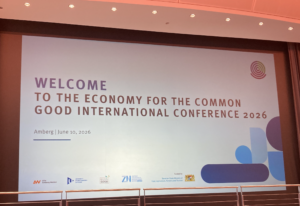
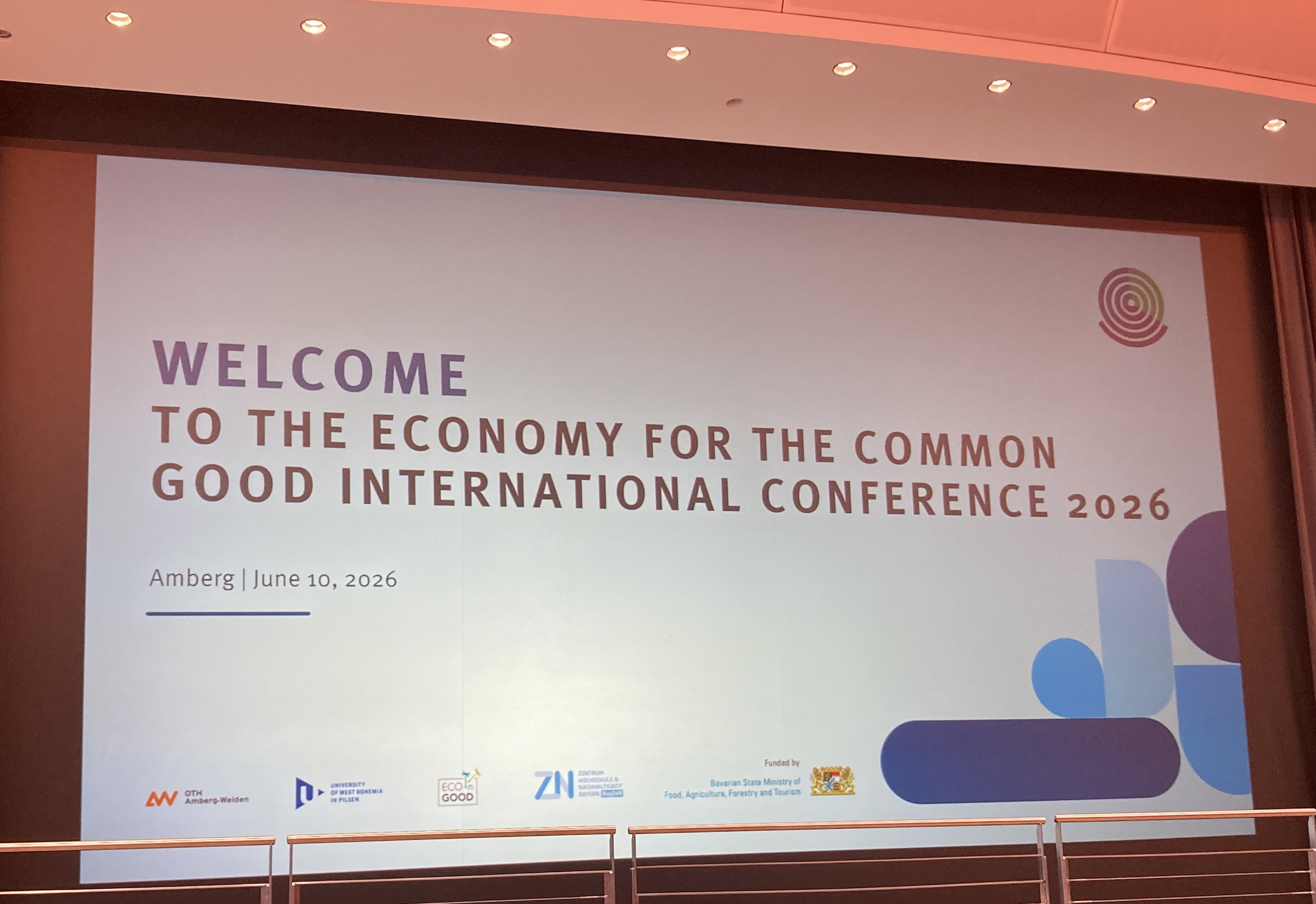
This month I am attending a series of conferences on economic transformation, each exploring from different angles the question of how we can live just and sustainably in this planet. Last week I attended the first of these conferences: the 4th Economy for the Common Good International Conference (ECGIC 2026) in Amberg, Germany. It was jointly organised by the local university and the International Federation for the Economy for the Common Good (ECOnGOOD).
But first, what is the ‘Economy for the Common Good’?
It is an economic model, which makes the ‘Common Good’, a good life for everyone on a healthy planet, its primary goal and purpose. It is based in principles of human dignity, solidarity and social justice, environmental sustainability, and transparency and co-determination. It can be applied to start-ups, businesses, municipalities and educational institutions. ECG has developed the Common Good Matrix as an evaluation and audit framework for various stakeholders as well as the ‘ECOnGOOD Label’ for businesses committed to these values.
Key moments of the Conference:
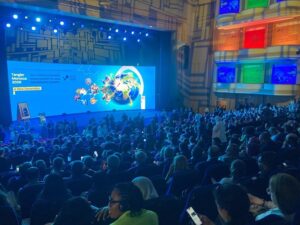
The conference’s three days were structured around three themes — Science, Practice, and Transformation — and had a rich programme of keynotes, parallel sessions, workshops, and poster presentations. Here, I focus on the four keynote presentations that impressed me the most:
Dirk Philipsen, Duke University – “Fences, Fortunes and Failures: The Legacy of Property”
Dirk argued that there is a structural tension between private property and the common good, and that to achieve an ECG we need to resolve the issue of enclosure, fences and artificial scarcity that capitalism needs and that we have been subject to.
- Private property runs on a system of exclusion, control and commodification of space and housing, to extract the exchange value from it.
- The common good prioritises the use value of housing, and proposes various ways to secure the right to housing without fences of private ownership, or ‘porous fences’ e.g. CLT, cooperative housing, public banks, common good enterprises, etc.
Hence the task is about fighting the artificial and manufactured scarcity (fences) around basic human rights and goods other people need, such as housing. Dirk and the Economy for the common good invite us to rethink the purpose of the economy to focus on human and ecological flourishing rather than in profitability.
This quote stayed with me: “The question is not if transformation is realistic, it is if continuing in our current path is”
Lewis Akenji, Hot or Cool Institute – “Reimagining the future for an economy for the common good”
Lewis started with a shocking graph to shows the challenge we have: the scale of the carbon emissions radical reduction we need to do to meet 2030 and 2050 targets:

I agree that we cannot address the environmental problems, until we address the social tensions and the systems behind current production, consumption, and waste levels and our ways of living in different countries. That difference and that conversation is the global social justice issue.
Lewis took us in an imaginary journey on things we can do now to achieve a radically different future, for example, what if by the 2040s we are applying the universality principle, acknowledging that some things are not for sale? This means establishing a social floor for dignified living, editing out harmful and carbon-intensive consumption options, and and editing in universal basic provisioning systems in urban sytems e.g. housing freed from speculative financial investment, public and non-profit transport, decommodified food systems, etc. What if by the 2050s we reclaim the commons and govern natural resources as shared global assets, a new social contract is anchored in democratic participation, we have equitable resource distribution, and collective responsibility towards each other and the environment. What if?
Here is a collage presented by Lewis with some ideas that can help us get there.

Sigrid Stagl, Professor of Environmental Economics & Policy at WU, the Vienna University of Economics and Business and founder of the Institute for Ecological Economics.
Sigrid presentation addressed head on the business case for sustainability transition. She stated that far from being an economic burden, the transition is actually the least costly option for businesses and investors, than if we continue business as usual. She showed a striking study from Deloitte on Dutch agriculture, which found that transitioning to plant-based protein in the Netherlands and reducing production intensity would actually be financially better for the sector in the long run, of course, that on top of its social and ecological benefits. Then it should be a no brainer.

Christian Felber, Founder of the EconGood movement
Christian made a reflection aboutour values and consciences of us as human species. Humans destruction of the environment is causing the extintion of approximately 5000 species per year. This is a massive human-driven loss of biodiversity. As he clearly stated “we have disconnected ethics from intelligence losing wisdom along the way”
So Christian states we need limits. He takes the Doughnut Economics diagram and adds a social maximum –limits on appropriation and accumulation– and an ecological minimum to guarantee basice human rights and less than 1/8billionth as a share of earths resources.

He outlined six concrete proposals, or limits, for implementing balancing feedback mechanisms in the distribution of income and wealth:
- Limit to income inequality, with both a minimum (living income) and a maximum income cap
- Upper limit on private wealth — a «wealth cap»
- Limit on the right to inheritance, paired with a guaranteed minimum inheritance for all;
- Limit on the size of companies;
- Limit on the total assets of banks; and
- Individual ecological budgets
As am writing this I’m realising that this proposal, while based on social justice and sustainability goals, it sounds very ‘limiting’, when in fact the ECG is about freedom and abundance. This is the difficulty with language. We should find better ways to communicate that these limits are on the disproportionate accumulation and appropriation of 1% of people in the world, while redistributing wealth and the sources and ownership of wealth for the 99% of people.
Evidence of that arose from an exercise he did with the audience on point # 1 above. A democratic assembly on what people of the audience thought would be the appropriate ration of minimum to maximum income in society. Our consensus was 1:5. He has done this exercise about 500 times and results oscilate around 1:10 ratio. Now let’s compare that to the actual income ratio we have today. When looking at the graph below it is easier to understand that the above ‘limiting’ picture that Christian proposes is not for most people in the world, but it is limiting a minority.


The rest of the conference: a constellation of actors working on their own piece of the ‘Economy for the common good’
The other sessions of conference where a collection of people working in very different things but all inter-related and in some way or another, towards the prioritisation of social and ecological values over economic growth for its own sake. Here are snapshots of the most impressive projects I was able to witness and learn from:
Thomas Schiffelmann on human dignity
Thomas works with Humanity & Inclusion (formerly Handicap International), a humanitarian organisation operating in 60 countries across the globe. He made the argument that the current economic system is incompatible with human dignity. He pointed to a contradiction that has also bugged me too for several years: SDG 8 and its specific targets on economic growth for its own sake, even called “inclusive and sustainable growth” are a contradiction. We can pursue inclusion and sustainability, and that may entail or not economic growth depending on the context, but the goal and objectives would be different. Hence Thomas states that a language of economic growth sole focus is not aligned with human dignity. He is researching different economic models, such as the EconGood to devise ways in which we can better align our economic system with human dignity across the globe.
Peter Bootsma and Jacqueline Hofstede on task democracy
«Task democracy» is an action-oriented model to coordinate voluntary transition efforts across specific societal or economic sectors. Rather than relying strictly on top-down legislation, this approach empowers collaborative, task-based councils to tackle specific societal or environmental challenges by acting for the common good (read more about their work in the Netherlands at: https://www.noordenduurzaam.nl)
Stef Van Dongen on the role of labour unions
Stef is a bright Master student who has already published part of his research and presented it at this conference. His study is called “Futures at Work: Labour Unions’ Viewpoints on Employee-Level Social and Environmental Sustainability”. His research used qualitative interviews with labour unions to explore how they understand and advance social and environmental sustainability at the employee level. He found that they are caught up between protecting their jobs in carbon-intensive sectors and advocating for the needed ecological transition their children will inherit. The study argues that workplaces present critical opportunities for just and sustainable transition — but only if unions are actively engaged as co-designers, not passive recipients of decisions made. See here a complementary study I did on the social innovation of labor unions highlighting examples of union-led climate actions for Building and Wood workers International.
Franziska Raedeker on Doughnut Economics in California
Franziska and her colleagues at the California Doughnut Economics Coalition are applying the Doughnut Economics framework at the scale of the state of California (the world’s fifth-largest economy), through the California Doughnut Economics Coalition, a worker self-directed nonprofit they founded in 2023.
In the California Doughnut Snapshot and Report, they evaluate the 12 social indicators (in the areas of food security, health, water, education, etc.) and 9 ecological indicators (like climate change, air pollution, ocean acidification, biodiversity loss, etc) for California. The results is a Doughnut completely out of balance: failing to meet the basic needs of a significant portion of its residents, while simultaneously exceeding multiple planetary boundaries, with a disproportionate impact on historically marginalised low-income groups. The results are not surprising, this is the case in most countries of the global north, and we can even see it as state level. The challenge of course is how do we fix that when California hosts some of the largest companies and richest people in the world. How do we apply the limits that Christian Felber talked in his presentation?
Kathy Otto on a living systems approach to designing organizations
Kathy’s MSP(E) model — Matter, Structure, Process, and Emergence — is an understanding and diagnost tool about the internal metabolism of an organisation. She taught us to see the different dimensions of institutions: their individuals, symbols, roles, spaces, rituals, and institutional structure. Seeing all of these dimensions together — rather than just the organisation’s chart or the strategy document allows us to understand why some things work and others don’t. When the internal workings of an organisation are aligned, the system flourishes.

Oliver Huffman on systems thinking
Oliver delivered a very interesting systems thinking workshop. Through a series of simple interactive exercises we were able to realise the interconnections between all of us, our networks and our actions. We as indiviudals and as organisations primarily think linearly, an action will bring about a reaction and then another one and so on. Oliver and this workshop made evident that what is visible is the physical world, and at most its interconnections, and above it, intertwined with it is the social realm where our personalities, thoughts and feelings affect our actions and reactions, and above and interwined with it is the structural or strategic realm, which is invisible, we are unaware of it and is constantly shapped by the other realms.
An interesting point made in the conversation is the role of time. Systems thinking not only works in the present but also in the past and in the future. Today, we are the result of our decisions, influences, path dependencies of the past, and today we are forging and creating the vision of the future, the one that we are able to imagine and to create. Hence, systems thinking is particulary important in the context of sustainability transitions, as we speak of ‘systems change’ we have to grip with complexity. This complexity is hard to even understand, let alone change it. This is a dosage of humility for us all working in transitions work, to realise that the challenge is huge, and all these constellation of actors working in the various different pieces of the ECG, are ‘small’ actions in a world of complexity and systems that seem immobile. However, systems thinking has also been very inspiring, acknowleding that everything is connected, hence our actions, words, thoughts and feelings –either postitive or negative– have bigger influences that we can even imagine. This is inspiring to trust ourselves, to push forward with an idea, a project, a challenge we want to tackle, because since everything is connected it will have a bigger impact than we can predict.
Conclusion: what I carry with me from Amberg
I found and will carry a community of diverse disciplines, geographies, ways of thinking and proposed approaches. We might not always agree with each other, we all have different methods, opinions and we push forward with what each thinks is best. We all hope to be right and hope that our actions will have positive consequences today and in the future. Among this diversity there is also unity around a shared conviction that the economy as currently constituted is not serving human dignity nor ecological health, and that this is neither inevitable nor permanent. That it can and should be changed.
These encounters also made clear that economic transformation is already happening, in fragments and in practice, across many fields and geographies at the same time. We have an abundance of alternatives and approaches, most are bottom-up. The key question and challenge for me is the economic transformation top-down, the missing political courage to pursue these alternatives with the urgency and the scale needed…. And afert a deep breath a remember a quote that stayed with me: “we have to take the chances. It’s not easy, but we have to. So much is at stake”.