By Alejandra Rivera, international urbanist and founder of Urban Matters and Adam Kiedrowski Chief Specialist at Poland’s Ministry of Climate and Environment, Department of Environment Education
For this second blog on this conference in degrowth I chose to write together with Adam Kiedrowski, the only representative of the public sector in this conference. I found it surprising, unique and hopeful at the same time, that members of the public administration are increasingly interested on alternative economic models and degrowth. Hence, for me, it was an imperative to include his perspective on the conference.
Why engage with degrowth?
In simple words, degrowth is an economic theory (and social movement) proposing that industrialised, developed, wealthy nations should actively scale down their material production and resource consumption. There’s a distinction cited by some experts between degrowth –which proposes a planned economic contraction of nocive sectors such as fossil fuels, weapons or tobacco industries and growth of wellbeing sectors such as education or health hence the point is that it is discerning about what we growth and what we don’t– and post-growth, which is more agnostic towards the concept of economic growth, abandoning GDP as a goal on itself and pursuing economic activities that produce wellbeing regardless of whether they lead to growth or not. Nonetheless, the idea is to replace the goal of increasing economic growth and its indicator GDP, with the goal of improving human wellbeing within planetary boundaries.
From the point of view of government administrations of European Union countries, degrowth is still seen as too radical and is not an officially accepted paradigm. The official EU position on sustainable development remains often associated with ‘green growth’ –the unproven assertion that economic growth can continue infinitely in an ecologically sustainable way. However, the ideas of degrowth have been growing strong among academic and activist circles, for example, through this conference, and it seems to be gaining more popularity in EU policy making, see for example this article on ‘perceptions of degrowth in the European Parliament’ and the Beyond Growth conference in EU Parliament.
These ideas are definitely new uncharted territory for public administrations, and initial rejection is understandable, but not justifiable. We commend open-minded public administrators trying to stay abreast of new trends, philosophical ideas and embrace the pressure to innovate and familiarize themselves with degrowth propositions. Moreover, degrowth ideas in many areas present very accurate observations and propose solutions for broadly understood environmental and social protections (See the work of Jason Hickel, Giorgos Kallis, Kohei Saito and the International Degrowth Network). Hence, one can simply draw on selected common-sense solutions that suit us and embrace the many degrowth-oriented initiatives already going on, this is precisely what public administrations can do.
The conference
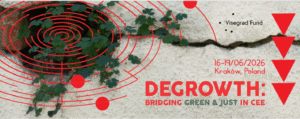
sectors of society under degrowth principles, especially in the CEE region. The conference was funded by Visegrad Fund and hosted by Jagiellonian University in Krakow. It brought together leading scholars and activists of the degrowth movement in Poland and in CEE. See here the full list of the programme committee and all those involved.
This conference explored degrowth in connection to various dimensions of our society and included sessions on food, culture, work & business, education, governance & democracy, energy, spirituality, inclusion, economy & money, non-humans, hope, mobility, infrastructure, etc. and was combined with various city walks, study visits, workshops, performances, discussions, and a diversity of activities for inspiration and exploration of the topic. For example:
IN EDUCATION
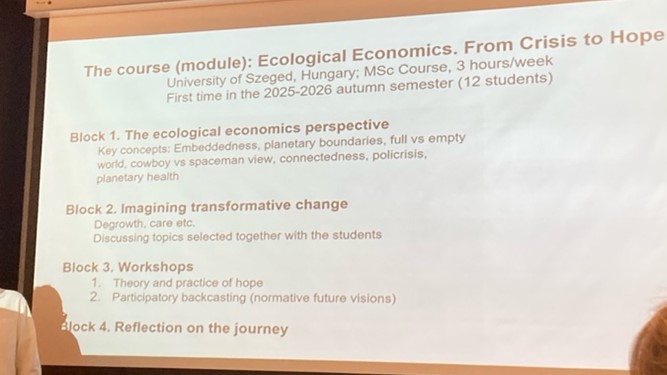
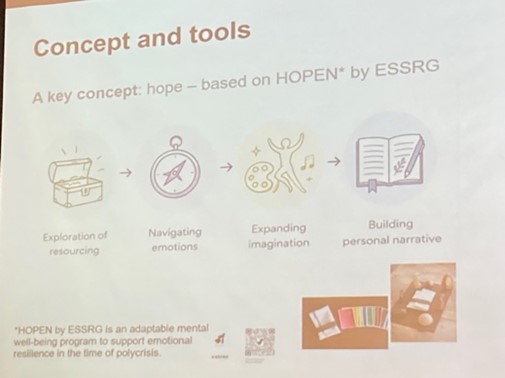
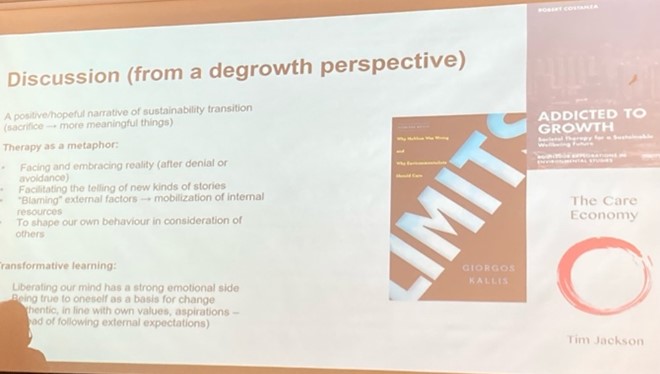
Zoltan Bajmócy and Barbara Mihók from the Institute of Ecological Economics, University of Szeged, Hungary presented “Hope, Emotions and Self-resourcing In Transformative Education For Sustainability: The Case of an Ecological Economics Course for Business Students”.
They presented about the class they run: “Ecological Economics: from crisis to hope” as an elective for Master students at the Faculty of Economics & Business at their university. It covered standard key concepts in ecological economics in block 1 below, but the remarkable thing about that this course is the focus on hope, on positive thinking and alternatives that students can take on the future. Zoltán pointed to the fact that when students learn about the climate change catastrophe, they are often faced with dismay and depression (and we don’t blame them, the scale and urgency of the problem is huge). However, Zoltán’s class perspective is important to not let students stand paralysed on the face of the challenge but surpass it to ‘imagining transformative change’ and going ‘from crisis to hope’.
Similarly, at the University of New South Wales in Sydney, I (Alejandra) lecture in the course “Law, urban sustainability and new economies” convened by Professor Bronwen Morgan. In this course I provide a general introduction to global sustainability issues, covering the global injustices of the challenge, why we need to act and why law students –future policy makers and lawyers– should care. I also cover some alternative economic models such as circular, diverse, Doughnut and sharing economies, as well as alternative business models and various forms of enterprise design such as B-corporations, non-profits, cooperatives, and trusts as instruments to create more just and sustainable enterprises and economies.
For me (Adam), this was the most important thematic block, as I work with environmental and climate education daily, and many of the ideas presented can be implemented immediately, without waiting for the entire economy to shift into degrowth mode.
For example, Małgorzata Kowalik-Olubińska from the University of Warmia and Mazury in Olsztyn presented the results of research on children’s outdoor education and the perspective of teaching that humans are part of nature, rather than nature as something separate from us. This is a foundational understanding of ourselves that underpins degrowth and doughnut economics among many alternative economic models.
Representatives from the Nausika Foundation in Krakow presented their educational games and outlined the general concept of using board games, RPGs (Role Playing Games), and LARPs (Live Action Role Play) in climate education. They presented games as an important tool for shaping attitudes, evoking emotions, and solving problems. They also demonstrated how games can be adapted to different audiences, from children and adolescents to adults.
Marius Matache from the University of Bucharest spoke about citizen engagement in citizen science, using examples from Romania. He highlighted the benefits not only for scientists and their research, but also its impact on public awareness.
Essentially, the presentations in this block about ‘Education’ focused on issues such as actively engaging recipients of educational activities and fostering agency, paying attention not only to raw knowledge but also to emotions, and pointing to the role of nature in maintaining human well-being. These are issues that are increasingly being addressed in environmental and climate education and not necessarily using the language of ‘degrowth’.
IN WORK & BUSINESS
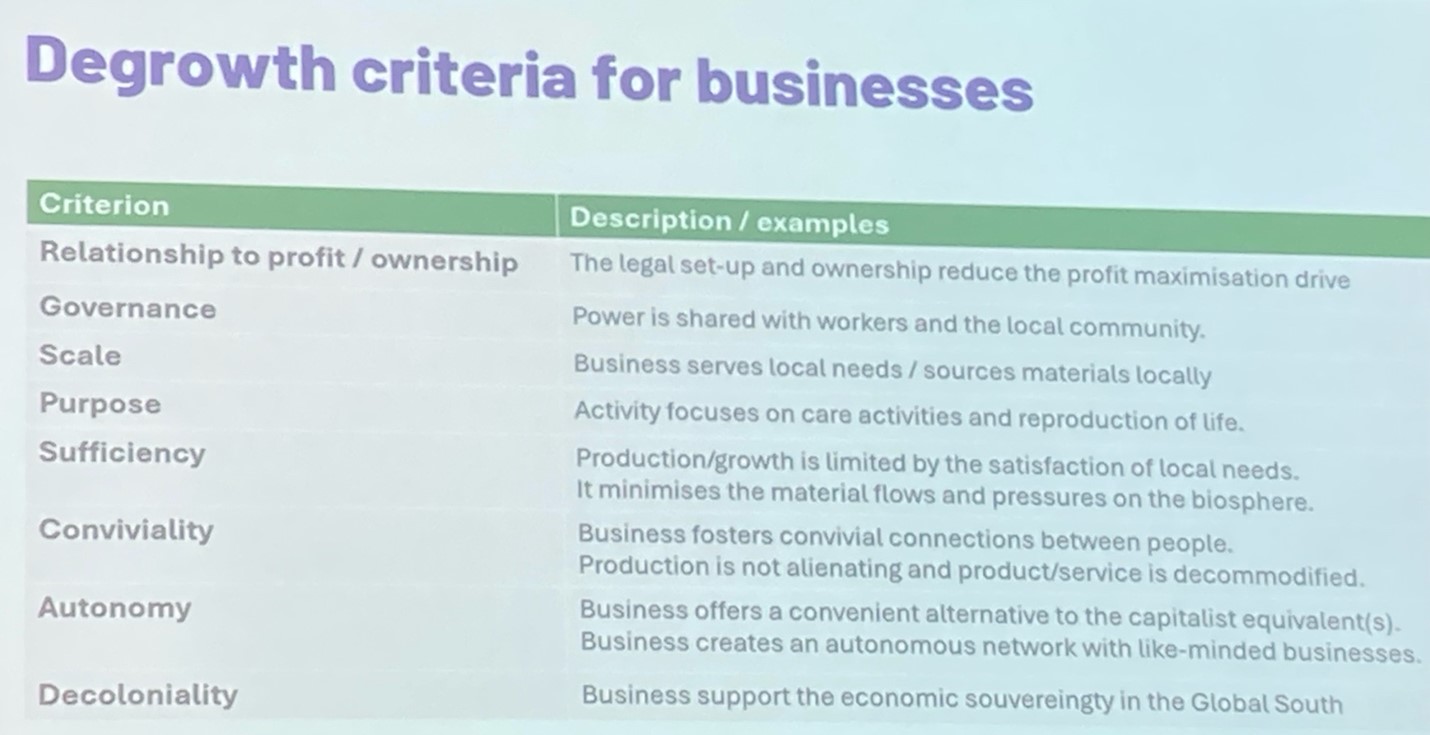
Jędrzej Nadolny ran a workshop to explore “degrowth-aligned businesses and their role in the degrowth transition”.
He addressed the contradiction between profit and sustainability –the pressure to maximise profits in a business ultimately puts pressure to cut costs, which often comes to the detriment of social justice (as low wages and poor working conditions) and the environment (as cutting corners to environmental protection): costs treated as ‘externalities’.
Jędrzej flipped this logic on its head and introduced us to the concept of “entredoneur” – someone who gives, rather than takes as a result of business activity. This proposes business less focus on profit-maximisation and more on satisfying basic needs and filling true (not artificially created) gaps. In this way, businesses can be underpinned by social and ecological values and still operate within the market e.g. Business cooperatives such as Mondragon in the Basque Country.
It is hard to imagine business (by the traditional market-oriented capitalist definition) to fit into this new imaginary and the ‘degrowth criteria for businesses’ but this invite us to push the edge of what is conceivable, envisionable and eventually possible. For more on this see the pioneering work of Jennifer Hinton on non-profit businesses, Melanie Rieback on post-growth entrepreneurship, and the Doughnut Economics Action Lab (DEAL) on Doughnut for Business.
IN POLICY
This is perhaps the most difficult aspect of our society in which to imagine degrowth. In our current capitalist system, economies are supposed to grow, if not there is a recession, politicians have the objective to increase GDP as that’s what most people associate with ‘the economy is doing well’ and therefore with their individual prosperity. This erroneous thinking needs to change. There is a better way in which economic growth (and its indicator GDP) is not a policy objective on itself (e.g. increases in the sales of weapons, tobacco, fossil fuels, SUVs, all will contribute to economic growth/GDP but not to wellbeing nor sustainability). Degrowth –and the various similar alternative economic models– propose to refocus our political goals and objectives with social and ecological wellbeing, and therefore be discerning on which industries should growth, and which ones shouldn’t.

We think the degrowth proposal has had a hard time penetrating political discourse because of the language that is used in activist and academic circles, the word itself ‘degrowth’ speaks of decreasing, reducing, and limiting, all have negative connotations of scarcity. However, degrowth is in fact about living in abundance, just under another political and economic configuration. When we go beyond the language and look at concrete examples of its implementation, this becomes clearer. Take for example the case of Girona ‘a postgrowth municipality’ which in 2024 signed a memorandum of understanding with ‘Research & Degrowth’ to develop public policies that pave pathways towards the post-growth city. These include, for instance, re-localised production, redistribution of wealth, more jobs with less working hours, and collective over individual values.
In the conference, we encountered the pioneering work of Ajda K. Pistotnik from the Policy Lab in Ljubljana, Slovenia a progressive think-and-act tank that researches and educates on degrowth with the goal of driving social and economic change for an economy where people and planet matter, at the end that is what matters the most for people. Policy Lab explains it in a very clear way, let’s think of “degrowth as a transition and post-growth as a destination”, and organisations like them helps us envision the steps to get there. They organise the ‘Degrowth International Political School’ which focuses on building relationships, trust, narratives, language and strategic thinking. Ajda did a joint presentation with her colleague Mladen Domazet from the Institute for Political Ecology “Green Academy” in Zagreb, Croatia. This is a similar research and educational organisation that designs alternative economic frameworks as part of that ladder towards post-growth futures.
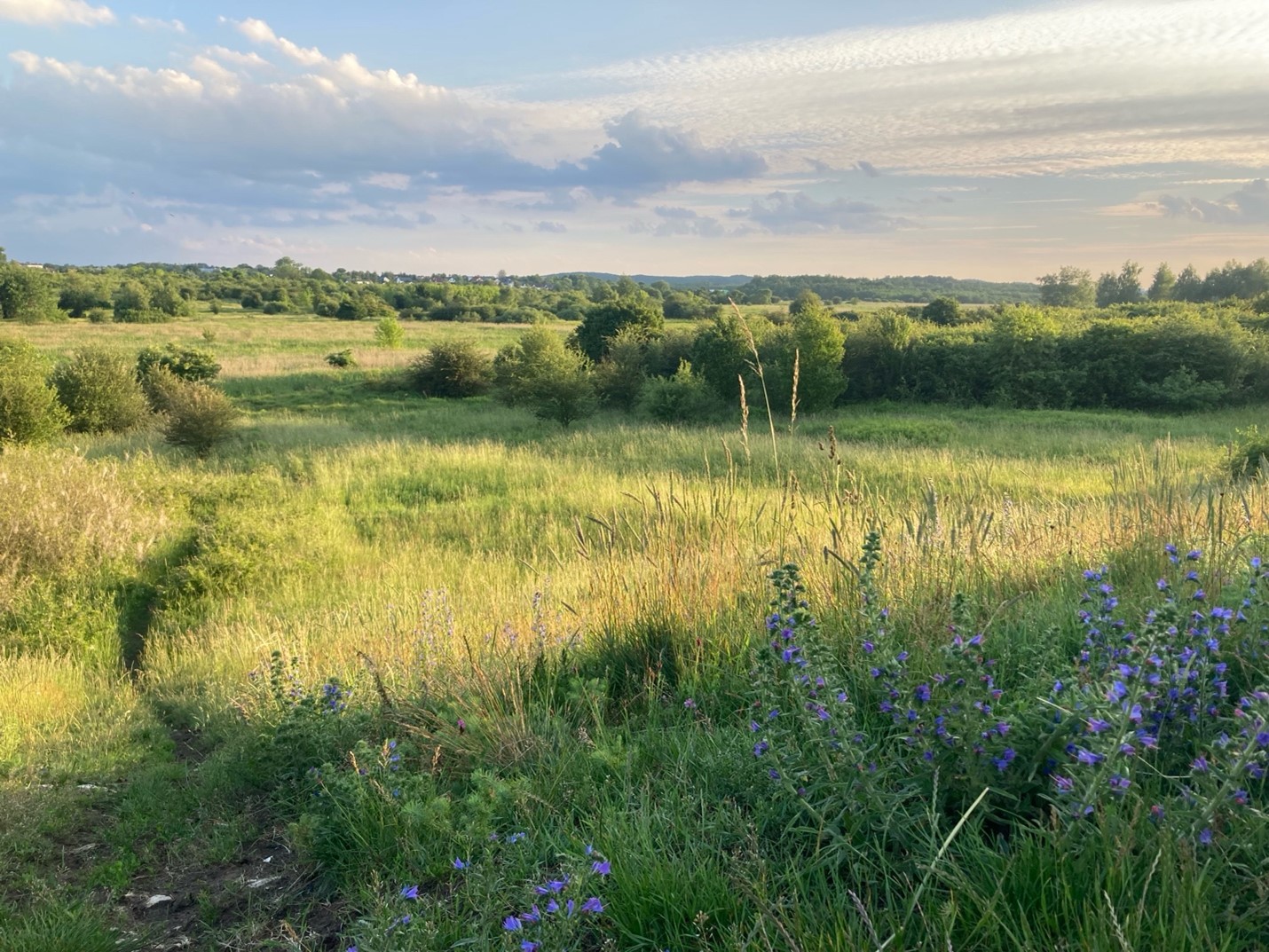
Photo taken by Alejandra Rivera during a nature walk at Pychowice, Kraków – 17 June, 2026
Furthermore, it seems that degrowth is already happening in many areas, even if it is not called that. Even those involved often do not realise that what they are doing is consistent with refocusing goals away from GDP and towards socio-ecological wellbeing. In Poland, for example, renewable energy development is increasingly based on energy cooperatives. Urban allotment gardens are returning in popularity, and those without access to them can get involved in the many neighbourhood and community gardens. Trendy second-hand clothing stores can be found on almost every street. One of the most popular groups on Polish Facebook is dedicated to donating all kinds of unwanted items for free or for a small fee—from clothes, to children’s toys, to furniture. Huge changes are taking place in school education in Poland. Climate-related topics are becoming increasingly broad, and the core curriculum explicitly states that preschool children should learn that humans are part of nature. Furthermore, a plant-based diet is being introduced more widely in school cafeterias, with mandatory meat-free days and the requirement to prepare nutritious vegetarian meals for all students who wish. The role of policy makers is to create the policy infrastructure to embrace, support and expand these already-existing initiatives.
All of this is a source of inspiration for Urban Matters, where we are mapping organisations at the forefront of the eco-social transition and state-of-the art tools, resources, and frameworks to build a repertoire of possibilities and support for policy makers. With this, we aim to provide clarity and direction in policy and accompany public administrators open to experiment with courageous bold ideas and to start or accelerate their eco-social transitions.
Overarching thoughts
Agoras such as this one become a melting pot of ideas, perspectives and ways of thinking. The presentations heard, the brainstorming in workshops and the conversations over coffee breaks, all shaped the path and tools we have, to make the world a better place. Sometimes is awareness, recognition or inspiration, some of these were:
- All types of activism are valid and are important. From jumping around in a snail custom to high-level political advocacy at the COPs, to grassroots groups working locally protecting forests, to organisations showing immigrant solidarity, fighting homelessness, promoting collective housing or just providing a safe space for other collectives to meet…. Everyone, every act, every initiative, every space of activism for change is an important piece of the puzzle that we are all moving on the same direction.
- Innovative approaches to activism can make all the difference. At the conference we were lucky to witness the marvelous artistic performance of Amanda Douge. She is award-winning actress, writer and poet, now doing a PhD at the University of Glasgow on how language and art can activate and trigger agency for climate transitions. In her performance, Amanda used her talent in acting and theater, academic theories on political economy and inspiration from the political poet Rosa Luxemburg, and merging all of this, she provided a theatrical act with drama, satire and humor about the contradictions of our current approaches to sustainability and made a wakeup call to more profound actions at systemic levels. Amanada was able to penetrate people’s desires and motivations with words and move emotional strings within them. She reminded us of the power of feelings and experiences to inspire and spark action. A beautiful and powerful form of activism we urgently need to bring to politicians, investors, corporations and COP negotiation rooms.
- The other half of basic needs: We tend to think of satisfying basic needs with material consumption, at least to a basic level to cover our requirements for food, water, shelter, etc; but there are also immaterial basic needs such as: sense of belonging, purpose and connection that are usually less prominent in our advocacy of human rights. These are equally important and could be nurtured through social relationships, solidarity, reciprocity and community building, much of what the community-based practices of degrowth and similar economic transformation movements advocate for.
- A simple goal: wellbeing. Beyond the multitude of frameworks, theories, language which can be rich and nurturing but at times divisive, let us all focus on that one simple and powerful guiding compass: wellbeing and its social and ecological goals. Let all our work, actions, activism at all levels, in all sectors, and with all people be directed towards achieving wellbeing and quality of life. Let our diversity of approaches on how to do that be a source of strength and possibilities, rather than division or competition. Let us embody and practice what we advocate for.
- From ‘either-or’ towards ‘both-and’: This conference, especially in the CEE context, invited us to go beyond false dichotomies: black or white, socialism or capitalism, etc. Debate of ideas and the fruitful exchange of perspectives is healthy, but much time and energy get lost in indefinitely debating pros and cons of either model and which one is better, and we get locked into one or the other. This conference and its people, this community, were pure evidence that for transition work is not about ‘either-or’ but ‘both-and’. It’s about the ‘in-between’ extremes, borrowing what works from each side, incorporating guardrails and lessons from both, and adding the imagination and creativity of alternatives that have not been written yet. Those are the bridges we are building.