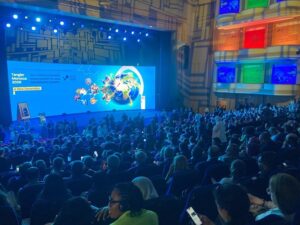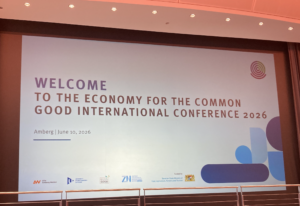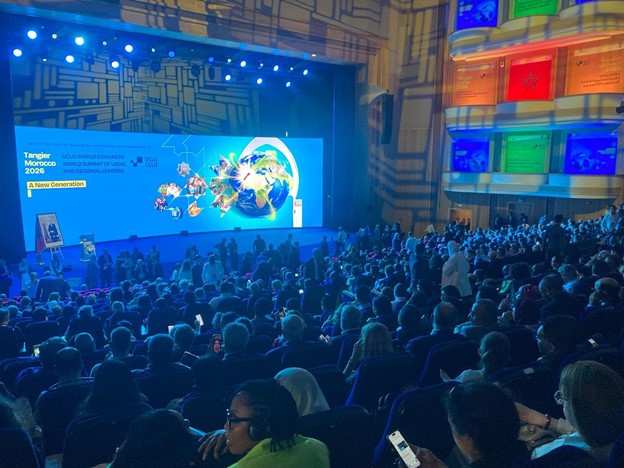
Photo taken by Alejandra Rivera at the UCLG Congress opening ceremony June 23, 2026
Reflections by Alejandra Rivera
The third stop in my journey of conferences across Europe was a very different one. So far, I have attended two conferences on the idealist side that dream of possibilities: the first in Amberg on the ‘Economy for the common good’ and then in Krakow on degrowth. Then I crossed the Mediterranean to go to Tangier, Morocco to attend the UCLG Congress World Summit of Local and Regional Leaders that took place between 22-25 June 2026. This was rather a gathering of people on the realist side: grounded in the current challenges of their cities, in dealing with their respective opposition parties, or public scrutiny or the media.
Why the focus on Local Governments?
I have followed the work of UCLG and Metropolis for almost 10 years. I continue to be impressed by the collaborations that can be done city-to-city through decentralised international cooperation and the power of joint advocacy that cities can have in international arenas such as the UN. I included this conference in my itinerary because it is precisely cities and local governments who have the power and authority to create change through policies, regulations, investments, procurement and strategic plans, if there is political will. Throughout my career I have worked in research and advocacy of various social and sustainability issues, and I have witnessed the big difference that a policy, government programme, or effective implementation makes. Therefore, when we are seeking impactful changes in social and ecological issues, the importance of the public sector is undeniable.
The precipices encountered
Especially attending the UCLG congress immediately after attending a conference in degrowth just the week before, the environment felt a complete opposite. The differences in the size of the event, the kind of participants, reason for gathering, topics on the table, and international outreach were abysmal. I supposed it was to be expected, but attending this UCLG congress for the first time, I was also struck by the number of photographers and reporters from communication teams of the attending cities. Each was keen to capture, document and showcase what their respective government officials state at the congress.

Photo taken by Alejandra Rivera at the UCLG Congress opening June 23, 2026
Abyss 1: on interactions
The event itself was also very formal, ceremonial and official; filled with rhetoric, various commitments and agreements being signed, and its respective dosage of city marketing. The format of the council and assembly sessions was mostly unidirectional: a person presenting to the audience or in a panel each person delivering their previously prepared timed speech, speaking in siloes, with little interaction with the audience or even between them.
In some smaller sessions and workshops, where local governments participated, there were more opportunities (or time) for questions from the audience, having some more interaction and dialogue. So, while the congress itself allows for networking and many organisations and governments are already working together, the spaces, time and format for interactions could be maximised. In upcoming congresses, I look forward to seeing more interactive and conducive formats for closer dialogue between governments and other sectors such as civil society, NGOs, academia, and the private sector.
Abyss 2: on sustainability
I also found little congruency between the conference sessions on sustainability / local climate solutions and the (un)sustainable actions of the conference itself and by the local organising committee in Morocco. Simple things caught my eye such as the myriads of plastic bottles used throughout the event. As a thirsty participant running around all day in 30C in Tangier I appreciated the water, but something inside of me crunched for participating in the insane amount of plastic waste in a matter of 4 days. Water dispensers and everyone with a refillable cup would have been better.
For dinner, after sunset about 8-9pm, there was no need to have the air conditioning at full blast to the point of being cold, when the weather outside was naturally cooler. Dinner itself consisted of various dishes of meat which didn’t seem to be a contradiction. Also, the amount of food brought to each table was probably x5 what was necessary for the guests. To our heartbreak, it seems a lot more food went to waste than what was consumed. It was a painful display of wasteful abundance and opulence that focused more on impressing than in sustainability. I would have been happily impressed if careful consideration is given to the carbon footprint of the event.
For this type of events, especially when organised by cities and local governments, part of the social and environmental responsibility should be to include clear guidelines and requirements of service provisioning by providers that are aligned with social and environmental values. Procurement is a powerful tool to show what an event and its organisers stand for. For example, for catering avoiding contracting large corporations, but rather prioritizing social and solidarity economy options e.g. catering done by local cooperatives or social enterprises sourcing local food, etc. as well as a responsible management of waste, trying to avoid plastic all together or at least reduce, reuse and recycle it.
I am conscious single actions like these at one event are not as significant as the difference entire sectors can make, in the scale of the transition needed. While every bit counts, I make this point here mainly for what these actions symbolically say about the consciousness of environmental issues among the organisers and the cities they represent. E.g. if a mayor attending this event does not crunch at the amount of plastic, energy waste and food waste in their own table, how could we expect them to design and implement effective sustainability polices in their own cities?
Abyss 3: on narratives
The third abyss that I found was on the themes of the sessions, at least the ones I attended. There was a range of topics in the programme that can mainly be clustered in either social, environmental or economic topics. These included for example:
- Social topics: public services, care, women’s rights and violence prevention, equity, democracy, peace, housing, migration & diaspora
- Environmental topics: Local climate solutions, circularity, losses and damages by climate change, and recognising ‘ecocide’ as a crime
- Economic topics: green growth, inclusive and sustainable economic development, industrial transformation, role of artificial intelligence in cities, and financing for urban development
The range of topics was impressive, and some sessions did seem to combine and make bridges between social, environmental and/or economic topics, however in most sessions I attended these clusters of topics were often treated in isolation from each other. In a world of polycrisis, complexity should be embraced, rather than dissected. Urban challenges cross multiples domains of human knowledge, hence our expertise should come together under multidisciplinary discussions acknowledging the inextricable links between the social, ecological and economic issues we are facing, which are deeply political.
Perhaps the feeling of this abyss was reinforced by just coming from two economic transformation conferences where social, ecological, economic and political domains are interwoven by default. Hence, observing these disconnections throughout the congress’ programme and attended sessions, made evident how much work needs to be done in integrating domains of our thematic knowledge and experiences, as well as integration of different sectors especially the academia, civil society, activists and NGOs with local governments.
Somehow, we must connect the precipices between these worlds and create bridges that allow us to imagine, design and implement together eco-social transitions in our cities.
Foreseeable bridges: human rights and the value of the public good
Being conscious that perhaps the first half of this blog has been critical, now I want to focus on what gives me hope, on what I observed at the UCLG congress that impressed me in a good way and motivated me to work with others aligned with causes of social and ecological transitions.
Throughout the congress, and on the face of precipices above, I caught a sight of the bridges that could be foreseen between (a) the world of advocacy for economic systems transformation such as the ‘economy for the common good’ or degrowth and (b) the different issues being discussed at the table by cities and local governments. There are at least three bridges:
1. Public services
The fact that the congress theme was “New generation of universal local public services” was refreshing. The value of public service provision is very present within academic, activists and advocacy circles, but when contrasted with the narratives of cities at the global level, in past years there had been a mix of governments pro privatised services with those pro public services. I was happily impressed by cities in this congress now having a congruent unison call for public services, and with an emphasis on their locality and universality.

Photo taken by Alejandra Rivera at the UCLG Executive Bureau session at the UCLG Congress
June 23, 2026
I attended a UCLG Executive Bureau session where UCLG signed the “Global Framework Agreement on Social Dialogue and Cooperation” with PSI (Public Services International, the global union federation of workers in public services). This agreement will establish a space for social dialogue between Local and Regional Government employers and their workers. This is a good step in the recognition of the importance of public services in our cities and of public service workers. The celebratory mood for signing this important agreement was accompanied by interventions from San José, Costa Rica stating that “public is better than private” as it distributes better the value created. I particularly liked the intervention by Paola Pabón from Ecuador, also UCLG vice-president, who warned that there is currently a concerning reduction in public services across Latin America, where existing high-quality public services are systematically weakened to privilege and give advantage to private business, which must not be tolerated. She stated this is an issue of ideology and service provision models and emphasised the fight for the public infrastructure and public services should continue.

Photo taken by Alejandra Rivera at the UCLG Executive Bureau session at the UCLG Congress
June 23, 2026
In their essay “From monopoly to commonspoly: how communities are changing the game” Lorena Zárate and Sophia Torres make a compelling case for the commons, which is another way of seeing publicly-owned services –a company or organisation whose mission is to serve the citizens and look for their public interest, not private interest. They provide an opportunity for collective governance of common goods or provision of common needs, which also helps address power imbalances given its democratic nature. In their essay, they recommend two sets of specific strategies for local governments: (re)municipalization and public-community partnerships. Hence, it is fundamental that at the local level, public administrations seek to defend social and solidarity economy actors from privatization pressures and promote democratic processes in service provision of common needs.
2. Public housing:
The dialogue “Housing Futures: Foresight for Cities Delivering Homes for All” was organised by Metropolis and chaired by Jordi Vaquer. It was a panel consisting of Djillali Lahiani (Deputy Major of Toulouse), Jordi Castellana (City councillor of Barcelona) and Jan van Zanen (Mayor of The Hague). I was glad to hear and perceive the consensus that housing should not be treated as a financial asset, but as a public good. All speakers agreed, and especially Van Zanen mentioned that, in The Hague, new development projects being built now should include 80% affordable housing (how we define ‘affordable’ is another subject for discussion) and he stressed the need to see housing as public infrastructure.

Photo taken by Alejandra Rivera at the dialogue “Housing Futures: Foresight for Cities Delivering Homes for All” at the UCLG Congress
June 24, 2026
As an advocate for social justice, housing rights and the right to the city myself I have attended various discussions at high-level events such as COP27 and the World Urban Forum 12. In the past few years, I have sat at panels where ‘housing investments’ and privatisation were proposed as profit-making mechanisms to promote economic growth in cities. These were discussion spaces where I enforced my role of housing advocate to question such thinking and intervened to reframe housing as a human right, and not as a commodity. Hence, coming from those experiences, the narrative that I encountered at the UCLG Congress about the defence of housing as public infrastructure and recognising its social and public value, indicates an important narrative shift from privatisation and towards municipalisation and public service provision among publicly elected officials, which is very positive.
3. Human rights
Another important bridge that I saw was on the area on human rights and the right to the city. I attended a session organized by UCLG in collaboration with the Office of the High Commissioner on Human Rights (OHCHR) and the Global Platform for the Right to the City (GPR2C) launching The New Global Charter-Agenda for Human Rights in the City and accompanying Guidance Framework for creating a human rights city. These are two complementary strategic roadmaps designed to embed international human rights standards into local governance and everyday urban life.

The session was led by Adria Duarte from the UCLG Committee on Social inclusion, participatory democracy and HRs, and the panel included representatives from Mexico City, Quilmes and Santa Fe in Argentina, Tripoli, REFELA (The Network of local elected Women of Africa) in Togo, Instituto Polis & GPR2C –all from the Global South, or rather the majority world. There was consensus in the room about the importance of the ‘right to the city’ –the right of citizens to be politically active in the making and shaping of their cities– and of ‘care’ as human rights. It was a hopeful bridge to see this example of committed local governments implementing progressive social agendas in their cities: including decentralized government, municipal plans for gender equity, bringing closer the government to the people, etc. Remarkably, they pursue these ideals and achieve them in the midst of national political instability or in contexts adverse to democracy and human rights.
Overall, the UCLG Congress –an advocacy platform– helped to provide a window into the current narratives and most salient issues for cities and local governments at a global arena.
I found a precipice between the topics and attitudes on the very official tables and what I would have liked to have heard more of at such global platform, such as integration of ecological and social issues and advocacy for eco-social wellbeing over economic growth in our cities. We are not there yet. I found precipices on the interactions –lacking presence of other sectors, on sustainability –incoherence between verbal commitments and actual actions at the conference, and on narratives –social, environmental and economic issues in siloes.
Nonetheless, I also saw bridges between these deep precipices. I saw a unison voice pro public services, public housing and the value of the common good. This is a valuable bridge to the value-driven goals I heard a few weeks ago in Amberg, at the ‘Economy for the common good’ conference. I saw passion and courage on the voices of various local governments, people and organisations standing for human rights, democracy, equity and for life, and I saw a lot of work left to do.
Urban Matters aims to harness these opportunities and bridges to promote and facilitate eco-social transitions in our cities.